Happy you three! Happy the Race of Men!
Born to inform or to correct the Pen.
To profits pleasures freedom and command.
Whilst we beside you but as Cyphers stand
T’increase your Numbers and to swell th’account
Of your delights which from our charms amount
And sadly are by this distinction taught
That since the Fall (by our seducement wrought)
Our is the greater losse as ours the greater fault.
Anne Finch, Madwoman in the Attic, pg. 8 & 9.
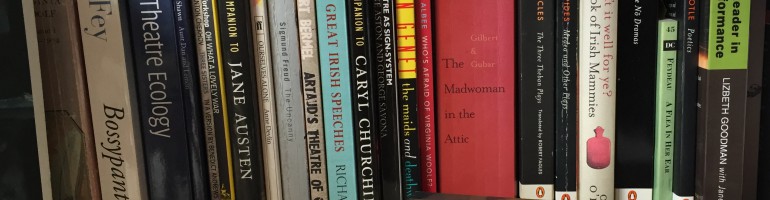
As a frantic third year during my bachelor’s degree, I ran around the library in my University continually frustrated with the literature I was reading, not to mention doing so while battling a hangover from hell. I couldn’t find any excitement in what I was reading because it didn’t relate to my anger and inquisitiveness (yes these emotions are quite close to one another), to what I wanted to try investigate as an upcoming dramaturg. I was constantly reading amazing literature from theorists like Judith Butler, Horkheimer and Adorno, brilliant mad men like Brendan Behan, and daring women like Marina Carr. But I wasn’t really getting that itch in my foot to kick arse within a theatrical space. Then I came across Anne Finch in the book Madwoman in the Attic by Gubar and Gilbert. I made this discovery while trawling through the bookshop Hodges and Figgus, trying to get more loyalty stamps so I could get another €10 off. I like to believe it was some magical literary moment, where the Gods of all the books in all of the land guided me to this book by some ephemeral music, and little fairies that live in bookshops lets call them ‘bookellas’, shouted with enthusiasm for me to buy this book. Unfortunately none of that alchemy actually occurred; the reasons for purchasing this book were superficial and mundane. I was attracted to the strange picture on the front cover and it was on discount with the other book I was buying. What is true is that it was “love at first read”. This entry is about how I became to understand the position of women and the impact they have in theatre. Specifically with the work of Caryl Churchill. Hopefully it maybe helpful to yourself as a reader to understand feminism and theatre.
Madwoman in the Attic is a literary analysis of the great nineteenth century female novelists. It is an interpretation that creates a thorough discussion about the female author, the construction of the female imagination and how women have been trapped in a liminal state of patriarchal standards of writing and constructing art. The reader is left with an expanded sense of awareness of the conventions that women in art and theatre are confined within. The reader is advised from the onset, that the approach to this work necessitates the ability to ‘examine, assimilate and transcend’. To truly make a positive change, a shift in consciousness is what’s required, therefore, we must follow that process. It is not about demolishing, but analytically deconstructing the representation/semiology/linguistics of the female identity for the purpose of better growth for women, that they are not trapped in ancient forms of traditions, expectations and standards. That they are truthful to themselves which then filters to the construction of the female imagination and product. As a whole, their work investigates the traps women have unconsciously fallen as authors and readers, that we must take note of absolutely everything to truly create an authentic female. In doing so, feminism has achieved what it has set out to do, to create equal platforms that answer the needs of both genders equally. Bringing fourth, women and authors in the present moment, and the issues we must be aware of.
During my last year in college, I was completely and utterly fascinated by the work of Caryl Churchill. Cloud Nine, Top Girls and This is a Chair, entranced me by the intricacy of detail and dramatic scope, with a political and/or social trajectory that could make you laugh and cry at the same time. Churchill’s theatrical technique of doubled characters was particularly thought-provoking because this played with the audience’s expectations and process of narrative digestion. Why were the characters doubled? I ventured into one of her earlier works Owners, before the doubled characters had emerged. Owners is about the power of ownership, where she almost blurs the lines of ownership of our bodies and our property. Ultimately the play ends with complete destruction, the set and the characters crumble. Work after Owners most commonly had doubled characters, what had changed? In Fen most of the characters were quadrupled. While studying Churchill’s work, I did intensive research into four of her plays Owners, Fen, Cloud Nine and Top Girls. I was trying to find out the reasons for the doubled characters while exploring and the power they create within a playtext. Churchill has created all types of women in her plays, powerful women, conflicted women, historical women, who were divided between their idea of sexuality and the traditional ancient ideas of sexuality; women who were confused, irrational, rational, the list is endless. And what they had in common, they are struggling within an internal battle, they are in constant turmoil that divides themselves, creating fractures within the psyche, which brought my work back to Anne Finch’s poem, Whilst we beside you but as Cyphers stand. A cypher! What a perfect word to describe the construction of female identity. I do not say that with delight, but with some sense of relief and optimism, because this is the issue. Women have become cyphers to themselves because of the standards and expectations created by a patriarchal society. As women we have had no time to truly understand or even contemplate the needs and desires of the feminine principle. I am not talking about make-up and high heels, but women’s biological differences to men (child birth, menstruation, breasts). There is no room to be feminine within this society because it doesn’t exist. Instead we accept what is expected and get on with things. Churchill was visually exemplifying what women do everyday with her doubled characters, as a spectator this becomes troubling because, well, we have never witnessed this before or even begun to discuss this in any real way. Through analysing each play and the doubled characters I then created the Cypher complex to lend a higher understanding of the doubled characters and their dual images. Therefore the Cypher complex is a conscious and unconscious dual force of acceptance and rejection, accepting the male standards and male expectations and in turn rejecting their own biological femininity. I understand that it is problematic to define and theorise on this issue, but it is necessary, it follows Gubar and Gilbert’s process of examination, assimilation and transcendence. Resolution through all of the above as opposed to argument. I’m not a magician, I do realise problems are not resolved that easily, but I created it to begin a discussion with both women and men.
Furthermore I hope that creating the Cypher complex will help in the understanding of the construction and existence of certain female identity and female representation on stage and screen. And begin to create and accept feminine models of representation that answers the needs of women, that do not condemn women or men, but instead opens a dialogue for appropriate representation. It may appear to be a mad idea to some, utopian in efforts. It is not aimed at creating a utopia but to deconstruct and examine that what we perceive as truth in fact engulfs and enslaves women further. Decoding the cypher and solidifying the feminine.
To decode the cypher complex we can start by the following…
- Feminism for all-EVERYONE CAN BE A FEMINIST. It is not something you get printed on a t-shirt that you brag about to others, it’s meant to empower everyone. Please don’t be that person that says to a man ‘you can’t be a feminist, you have a penis’. Feminism was created to empower women and also to educate women and men about creating an equal platform.
- Stop judging women-Who cares what she is wearing, what she is doing, or how she lives her life, it is that woman’s choice. Nothing is achieved by being judgmental, let’s be honest it is just fear speaking when you judge. Encourage women and men to express their weird and wonderful selves, as long as it does not hurt anyone in a physical, psychological or emotional manner.
- Be kind-Before you shut down someone whether it is a woman or a man, try to gauge an understanding of their perspective. Be kind and understanding to everyone’s opinion, create a dialogue instead of a debate.
- SUPPORT-Women must support women, it is far more beneficial supporting one another. We can achieve far more if we invest our energy in supportive actions.
- Be understanding-I have heard a few of my friends and colleagues say ‘I don’t think I am a feminist because I have never read about it’. You don’t have to be erudite to be a feminist, to be a feminist is to have the desire and urge to want something better for all women. Fuck the books, create feminism based around you as a women and the women around you, what would help them. In turn as you help yourself and the people around you, it has this wonderful ripple effect.
The above points’ can apply to how you approach writing a feminist play. It does not mean you have to use the points rigidly but just to give you a higher understanding how a feminist play can operate, generate and hopefully create a new cocoon of thought about feminism in theatre in the current theatrical climate. One of which broadens our knowledge of feminism and encourages both theatre practitioner and audience to obliterate the fear of calling themselves a feminist, it doesn’t mean not shaving your armpits and making up plans on how to kill Andy Warhol, but to strengthen gender equality.
Thank you for reading this article, I would love to hear what you think about feminism and/if it has a place in your daily life. I will upload a bibliography of some books that I have read which have really helped me. And for any other information do not hesitate to contact me on the contact page. AND: remember…kick the fuck out of the day cause you’re amazing!
Thank you for reading!
All rights reserved to Katie Poushpom, k.e.cleary.
 The Madwoman in the Theatre.