Tips for Theatregoers and new Theatregoers

TOP TIPS FOR THEATREGOERS AND NEW THEATREGOERS

Have you ever left the theatre wondering ‘if only I had some tips to guide me in direction to possess the best skills imaginable so I can have the greatest theatre experience every time I enter the majestic auditorium doors’. Probably not, that’s a fairly long drawn out thought, something similar to a dramatic Shakespeare character not an audience member.

Below are some of my tips for regular theatregoers and new theatregoers to help you make the most out of your theatre experience.

1. Buying your ticket.

– Become familiar with the show you are going to see. Look up a synopsis or even a review. Why not check out social media land or YouTube, some theatre companies have entered the digital world and have fancy previews and visual teasers.
– Thanks to googletron, you can also find out what style and genre the production contains. That may sound like hard work, don’t worry it’s usually not that much reading involved and it will save you money and hassle in the future. If you are a Wordsmith and want some David Mamet-esque word play, it would be a wise idea not to buy a ticket to an interpretative dance based play.
– Once you have found the show you want, when you are buying your ticket try find a seating plan of the theatre. Some websites will already have the seating plan on the screen so you can pick your seat, but some sites have it on a separate PDF file. You would be surprised how many pillars are in one auditorium. And check out the height of the seat, you don’t want to be so high that you get vertigo. A lot of theatre spaces are very old, a time where the audience didn’t seem to mind visual obstructions and sitting so high up in the theatre that all you can see is the tops of heads.
– Perhaps you find the Internet quite threatening and confusing, it’s a large place with endless amounts of information, a topothesia created by James Joyce and as puzzling as reading Stephen Hawking’s The Universe in a Nutshell. If this applies to you, why not ring up the theatre and ask about the seating plan, cheap tickets that might not be available online, and restaurants or cafes around the theatre.

2. Night of the show.

– First item on the agenda what do you wear? What ever you want! Put on the clothes that make you feel jazzy and spiffy. Or you could take my following suggestions.
A CAPE- What happened to capes? Well to be honest they aren’t the most common item of clothing, mostly seen on the fictional character Dracula. Its 2015 lets change that stereotype, capes are incredibly luxurious and dramatic in its appearance but did you know it is also incredibly functional. If you become too afraid to what you are seeing on stage you can bring the cape up subtly to avert your eyes. Or you could pick up both sides of the cape with your hands and lift it in the air when you are laughing, showing visible theatrical happiness. Letting both the cast and production know you are REALLY enjoying the play. Women, men, children even babies can wear capes. Functional and unspecified to gender.

TRENCH COAT- Trench coats’ are brilliant because they have so many pockets you don’t have to bring a bag and still have space to buy a programme or even a copy of the play. Lack of pocket space and bag space is a common problem with attending the theatre. You usually end up carrying your coat or scarf and then end up balancing your belongings with your drink while trying to socialize. It starts to become a bit awkward and a work out. Not with a trench coat, they are light and have so much space it would make Ikea envious.

HEADSET- Maybe your goal is to fit in so much so the theatre thinks you are part of the company. This is perfectly achieved by wearing black clothes and a headset. Because people will think you are part of the company they will think you are in a rush or some sort of hurry, which will help you skip lines for the toilet or even the bar. For this accessory you need to have a tremendous amount of confidence or just be quick on your feet.

DO NOT WEAR! There is one item of attire that must never be worn at the theatre, which are high heels that need to be heeled. Why such a specific shoe and shoe description, because people who wear high heels that need to be heeled do not know how to lift their feet! Instead drag their feet as if there is a small angry overweight child attached to them. It’s not the noise of the shoes on the ground, but how they stab and scratch the legs and feet of the defenseless spectators sitting in their seats. They usually have a seat in the middle, of course, so this most likely will happen to you no matter where you are sitting.

3. Food.

As for food, the best advice is to eat at home. Food that is away from your modest fridge is usually very expensive and infrastructure will most likely leave you short for time. But if you don’t like that crude fact why not try the following.
– Bring a sandwich with you that you can eat on the go, it might give you indigestion but it will do the job.
– If you are insanely great for timing, check out the restaurants and cafes that exist outside or near the theatre. They usually do theatre deals if you present them with you theatre ticket (this is a genuine fact).
– Don’t bring food to the theatre, you’ll think you’re being smart but from experience the smell of tuna and onions can travel out of your lunch box into the noses of your fellow spectators, who are now glaring at you.

4. The Performance.

Before the performance starts make sure you have gone to the toilet, switched off your phone, make sure you’re in the right seat (didn’t know I paid for the queens box!) and make sure you get comfy as in visually, some times you may have to strategically position yourself because you are in front of a human giraffe. The only other thing to do is to enjoy the show! Here is some advice on what not to do during the show.
– Don’t wave at the actors, they won’t wave back.
– Don’t take any pictures, even if you take the flash off the picture will just look like shit.
– If you find something amusing and have a tendency to hit people when you are laughing, avoid doing so to the stranger sitting next to you. They may end up beating you verbally, its worse than physical harm.
– If you drop something on the ground, you can kiss it goodbye because there is an eclipse from your knees to the floor.
– Don’t call or text during a show- there is awful reception.

Best tip of all…be an active spectator! If you find something funny you can laugh, if you find something upsetting why not have a little cry into your cape. Or if you don’t find it funny or touching don’t feel self-conscience. Theatre is to be experienced not to put the fear of God into you that you are not doing the appropriate social activity. Unless you are going to a Punchdrunk performance, but that throws all rules out the window.

5. The Interval.

For those of you who don’t know an interval is a 15 minute break in the middle of a show where you can get a drink, have a chat and if you feel like it have a lavatory break. It sounds like a decent amount of time, but its not…

The minute you leave the breathy sauna of an auditorium you find out the loos are full, the bar is packed and you cant find the front of house for love or money and all you want is a drink a water and a map to try to find the front door because you cant use the door you came in for some odd unsaid reason. Don’t worry I have some advice, but not for the door, I have no idea why they do that.

– When the lights fade to black and the show ends you should already be ready to leave, bag in hand, feet already walking away from your seat. Go to the toilet first, the toilets are full in seconds and theatres usually don’t have a lot of toilets. But don’t run to them someone will tell you off, instead be like a swan, calm from the waist upwards and from the waist down, your legs better be going ninety.
– The bar, well if you’re by yourself you’ll think ‘damn why didn’t I bring anyone with me?’ By the time you’re finished in the loo the bar is already full. If you didn’t bring a theatre buddy with you, you’re best bet is to slide through the middle two innocent friends talking to each other, walk swiftly as if the bar person is calling you. There is a bit of acting involved, and you’re in the best place to practice this talent.
– If you want some food, well you should have eaten before you came to the theatre, where do you think this is your gran’s kitchen! And they most likely wont have any food, because hummus is a right shithead to get out of the carpet.

If you have five minutes to spare by some miracle, why don’t you…I’m only joking its impossible to have a spare 5 minutes during an interval.

6. Second half of the show.

Same rules apply like the start of the show, and most importantly enjoy it!

The only advice that could be given is to clap at the end of the show. Show how much you enjoyed it by clapping like a lunatic. Maybe even have a motorized dog tail attached to your back to really emphasis your joy and satisfaction. Be dramatic, you are in a theatre after all.

7. End of the show, the Foyer.

At the end of the show you might see a few people hanging around the foyer chatting away to friends. You probably will see some of the cast fresh of the stage and even the director. Why not approach them and ask them some questions you had about the show, obviously not while they are on the phone to loved ones. What theatre people have you heard of that doesn’t like talking about their show? That’s right, no one! This is probably due to the fact theatre folk have put all their money and time into producing theatre, they cant remember how to talk about normal things like the weather, politics or sometimes they cant remember personal hygiene.

The only theatre folk that don’t enjoy talking about their work is playwrights, that’s because they have just released themselves from their harshly lit computer screens and they are trying to readjust both their eye sight and mind to the real world. Playwrights can be fragile entities, be gentle.

One tip for foyer interaction is not to say ‘I didn’t get it’, instead ask ‘why was/ were….’followed by your query.

If this doesn’t go well and the theatre person isn’t very friendly, why not draw some classic moustaches and uni brows on their posters. Anonymous vandalism is effective and you wont get caught, unless you draw really slowly then you’re fucked.

8. After show chats/ Post show discussions/ Question time.

After show chats can be really interesting and insightful, they consist of the cast and some of the crew on the stage talking about how and why they staged their production. The main obstacles they encountered, creative opportunities they generated and some history about the company and their artistic theatrical efficacy. These discussions usually occur with a new production and happen at the beginning of the production. This is a really great opportunities to gain a higher understanding from some of your favourite performances straight from the horses mouth. These discussions can be thought provoking and informative that ignites passion and enthusiasm to both fellow theatre makers and the audience.

Although, these discussions can be an artistically stimulating place I must warn about a special type of person that attends every after show chats. No matter what theatre production you have attended theses unique creatures will always be found. They are called…the Theatre arse lickers.

Be prepared to be very agitated. But you must power through and pray to the theatre gods that they shut their mouths. The Theatre arse licker attends these chats in an effort to either network or gloat about their knowledge about theatre. Usually people listening eagerly cant wait to ask a question, but beware the theatre arse licker will get their first. They wont even ask a question they will just say an incredibly long statement about live performance being a ‘game changer’ then followed by a quote ‘they read on the way in’ by Foucault. Never making any real sense or picking up on the awkward tone by the director struggling to try find some kind of bullshit answer so the FOH can unclasp the microphone from their hand.

Other than that, after show chats are brilliant. And a good place to practice your ‘interested’ looking facial expressions.

9. Finally…
When you are going to the theatre make sure you are going to be entertained or informed by something that interests you. Theatre does not exist to make you look intelligent, it is a form of art that is to be experienced. There are so many styles of theatre out there that there is something for everyone in the audience.

Have a theatre-tastic day!

K.Poushpom ©

Leave a comment

Filed under Downstage discoveries

Time Vs. The Playwright

Time Vs. The Playwright- Post Challenge Thoughts

This challenge or more experience was the most intense test of endurance. When I began driving I had no idea what I wanted to write for about an hour, or even where to start writing. All of my playwrighting techniques fell out the window on the M50. In a moment of desperation I decided to write down, well my partner in creative crime Danny, wrote down everything that was floating through my head. Ideas like, five characters on a journey through the rain in some Joycean esque style, the birth of a brain bow; its like a brainstorm but more politically correct because I read an article that you are not allowed to say brainstorm anymore (also fact of the day). From this a political comedy was born, it was the mixture of the current water charges being introduced into Ireland and the floods we were driving through, such irony of water charges being introduced in such a naturally water filled country.

When we reached Sligo to find some creative inspiration from Yeats grave, I had written twelve pages. This was the first act, which was taking a theatre of the absurd tone. The characters were stuck in a funnel factory created to pump money into a water factory. From this strange mindset, we went over to Yeats grave to witness a slightly dark or maybe not gravestone inscription: Cast a cold eye/ On life on death/ Horseman, pass by. My initial reaction was unfortunately not one of a deep and profound poetic perspective; it instead provoked a question ‘WHAT DOES THAT MEAN’. This was probably due to tiredness already hitting me and my creative nerves wrought together in some horrible tangle. This induced a cloud of panic over me because I then realised I had to write the rest of the play, a forty-minute play in five hours…

The car journey from Sligo to Cork was not an easy one, first of all Google maps decided to bring us down the smallest road to be found in Ireland. Not sure if it could be classified as a road but an area of path surrounded by trees, human like looking trees who appeared to be frowning and smiling, or maybe there was something in my coffee I bought in the dodgy looking garage four miles ago. By this time creativity, imagination and my brain decided to go asleep for a while. Every 15 minutes I would think of lines of dialogue, and then suddenly could not think of anything. This is when a few rules were broken. Danny wrote a few lines in the second act and the final act. Danny also contributed to regaining some of sanity towards the end of the play like the coach in Rocky. Shouting chants like ‘You can do it’, ‘I believe in you’ and ‘You need to finish the play for theatre land’. Last one was a bit dramatic to say the least, but you understand the dramaturg and playwright dynamic that was created in the car, (which was another rule broken). This can definitely be witnessed in the play, the first act presents a lot of scope and characterization to where the play might begin to dramaturgically venture into, and then towards the play it abruptly ends by a typical Hollywood horror film. Thankfully it was finished all thanks to Google maps, which caused us to be lost for an extra hour and a half, which is also where I broke another rule.

Altogether with the numerous rules broken it adds up to €200, which is going to go to a theatre production on fund it. It may appear to be random but I strongly believe when you create theatre it should not just entertain but empower the audience and fellow theatre makers. Doesn’t necessarily mean financially but for this challenge I was unable to attend productions in and around Ireland so why not give someone a few spondulics.

Below is the finished piece of work, before you read it there is a rubric to consider: Read the play dramaturgically and creatively. Dramaturgically meaning does the play make any theatrical sense, and what do you consider to be the main flaws and opportunities within it if it were staged. Creatively, stay conscious of the time limit it was created within, how does that impact the play text?
I haven’t corrected a lot of the spelling and grammar mistakes within the play because I wanted to be as organic as possible, another prop to the finished piece.

In conclusion, it is fucking insane to write a play in seven and half hours, and like me you will probably end up writing one that is only about twenty minutes long. Or if you would like to try do one better, try to drive down roads minus cattle and forestry, instead find a road like on an American highway, nice and straight with no complications. Hope you enjoy reading the play, ‘Untitled’.

Thank you for reading!

All rights are reserved to Katie Poushpom© k.e.cleary

UNTITLED

ACT I
Internal:factory
The stage is dark, you can hear the cacophony of
mechanical machines operating.
Lights fade up to show three characters on stage.
Jake, Mildred and Daniel are on stage.they are
working on three separate tables with what
appears to be water funnels. There is a lot of
materials on the table accompanying the funnels.
All the characters are hard at work. There is a
huge clock upstage on the wall that doesn’t work.
There is a door stage left and stage right and
there is a window stage right but it’s bricked
up.
The atmosphere seems tense. The characters seem
on edge and every so often look at the clock to
check the time. But the clock still isn’t
working.
Daniel appears to have an idea and puts one of
the funnels on his head. He does so to attract
the attention of jake and Mildred.
Daniel: “Hey guys who am I?”
Mildred and jake dart their eyes over but get
back to work.
Daniel: “not even a laugh? I’m losing my touch.”
Milder: “Daniel not now we have to get this done
by the end of the day’ I’m not getting in trouble
again.”
Daniel: “you need to find the lightness in any
situation. Sorry if my humour is interrupting
your misery.”
Mildred puts her tools down on the table.
Mildred: “there is a time and a place to perform
your comedy act, Pauline won’t just kill you but
2.
all of us if she finds out we’re slacking.”
Daniel:(smiling) “that’s who I’m supposed to be!
Look!”
Puts the funnel back onto his head in a high
pitched voice says “it is what it is, do as I say
or i’ll eat your leg like a chicken wing”
Jake says in a quiet tone “that’s not even funny”
Daniel: “you wouldn’t know humour if it tickled
your asshole”
Mildred (to jake): “don’t listen to him just get
back to your work and hopefully we can leave
soon.”
Mildred and jake get back to their work.
Daniel: “what do you want to do when we get out
of here?
Mildred: “not with you!”
Daniel: “why?”
Mildred: “I already sacrifice enough of my time
in here with you I’m not going to sacrifice my
free time with you too”
Daniel: “my presence is like a shitty pilgrimage,
how wonderful. That’s a new one for me.”
Joan enters.
Joan is dressed in normal attire as opposed the
the overalls everyone else is wearing.
Joan: ” working away are we?”
Daniel: “finally some life to the party!”
Mildred: “do you mind finishing some of jakes
work? He’s a bit behind”
Joan: “yes but only for a little while, I need to
get out of here for a while.
3.
Daniel: “no stop, come have fun with me!”
Footsteps are heard.
There is a silence.
Joan looks up at the clock.
Daniel: “did you see that documentary on
jellyfish?
Pause.
Daniel: “they talked about jellyfish not actually
having a brain but are able to rejuvenate
themselves so they don’t technically die. It’s
the same with lobsters. They can keep growing too
so there could be a giant lobster out there
somewhere for all we know.”
Joan: “you always have such random information
Daniel.”
Mildred: “like that time you educated us on how
flowers are sentient beings.”
They all start to titter. Especially jake.
Daniel sees jake laughing and is unamused.
Daniel starts to walk over to jake as he is
speaking.
Daniel: “dunno what you’re laughing at jake, you
can’t go to the toilet without Mildred holding
your hand. I’d hate to think that something
horrible were to happen to you if Mildred wasn’t
there.”
Daniel takes a knife out of his pocket for only
jake and the audience to see.
Jake appears terrified.
Joan: “oh calm down Daniel, we only have a few
more hours left in here, you don’t want Pauline
giving you the sack before the end of the day do
you?”
4.
Daniel sits down.
Daniel: “only joking, just trying to find the
lightness in my situation.”
Mildred: “Joan you better get your overalls on
before Pauline gets back.”
Joan: “too late for that I threw them away.”
Mildred: “but she’ll go mad if she sees you!”
Joan: “don’t worry I know what I’m doing. We are
making fucking funnels not baking shortcake.”
Daniel: “viva la people.”
Pauline is seen at the door stage left?
They all put their hands on the table and stay
very still.
Pauline strides around the room observing what’s
on the tables.
She walks over to Daniels table and picks up one
of the funnels. She stares at it then throws it
on the ground.
Daniel flinches.
She notices that Joan isn’t in her overalls.
Pauline: “where are your overalls? And before you
answer, I do not give two funnel tubes what your
liberal or political stance is today. A simple
answer for a simple question please?”
Joan: “it is unfortunate we cannot see eye to
eye.”
Pauline: “eye to eye?”
I’m asking you to complete a simple job, but you
have to protest about that as well. Why would I
ever see eye to eye with you your not even the
same height as me.”
5.
Joan: “I don’t understand why we need to wear
overalls, it’s very constricting to the creative
mind.”
Pauline looks appalled: “let me put it this way,
there is a set of instructions on your table,
your tools and materials. It is there To keep you
safe and to complete the job with no fuss or
complications. Your creativity does not come in
to the equation. It is what it is so what is the
problem?”
Joan: “that is the problem! I need room to grow
and spread my skills. All of us do!”
Daniel, jake and Mildred all shake their heads in
disagreement.
Pause.
Pauline: “if you don’t do what I say then You can
get out, you are all replaceable! I am here to do
an important job, to make sure these funnels
filter water that is pure and perfect. You should
be happy to have a job and stable income, so if
you want to leave please do, if not I do not want
to hear another word coming out of your mouth.”
Joan looks defeated.
Long silence.
Joan: “good.”
She looks over at Daniels table.
Daniel (anxiously): “I wouldn’t look at my
finished product just yet…(pause).
Pauline looks at his table with great interest.
She then throws all of his materials on the
ground.
Pauline: “again! Do it again!”
Daniel: “I’ll do that right away.”
6.
Pauline exits.
Mildred darts her eyes up to the clock.
Daniel: “that old fart can never be happy,
sometimes I think she’s a robot.”
Mildred: “you wouldn’t have the balls to say that
to her when she was here.”
Jake (meekly): “are you ok Joan?”
Joan: “don’t worry jake I’ll be fine, you must
always be armoured when you are heading towards
the battlefield, Especially if you are fighting
for something you believe in.”
Daniel: “what are you gonna do now then ‘Joan of
Arc?”
Joan: “I need to think of a better plan to get
out of here.”
Mildred: “I wish I was as ambitious as you Joan.”
Daniel: “have you never heard the phrase, ‘people
plan, god laughs’?”
Joan: “have you ever heard the phrase, an apple a
day keeps the doctor away?
Daniel: “yeah, why?”
Joan: “exactly it’s just a phrase, creative minds
break them.”
Jake looks up at the clock.
Pause.
Mildred: “what do you think you’re going to do?”
Joan: “all I know is I need to get out of here
and go find a future elsewhere.”
Jake looks up at the clock.
Jake: “can I come with you Joan?”
7.
Joan: “of course you can jake. There a whole big
world out there of all of us. You guys can come
too but you have to leave here with me today.”
Daniel, jake and Mildred all look at eachothers
shocked.
Daniel: “you really are mad, we can’t go today,
today is the launch of The MEGA funnel! You’ll
never get out of here unnoticed. They’ll drag you
back in to finish the job.
Joan: “not with that attitude pessimistic
Patricia.”
Mildred: “maybe we should just stay here for
today and try tomorrow. I’m a bit tired for a
revolution.”
Joan: “that’s exactly when you need to start
fighting. Don’t worry it’ll be easy.”
Daniel: “easy to never find a job again.”
Jake (meekly): “I still want to go its worth
risk.”
Daniel: I’m all up for a revolution but I still
want enough for my chicken fillet roll in the
morning.
Joan: I’m leaving today with or without
you.things are just going to get worse and worse
if we just stay here. And when I leave I’ll be
safe in the knowledge that I’m doing the right
thing for myself and the world.
Daniel: oh stop with the hippy bullshit Joan,that
is isn’t going to pay for a train ticket.
Jake: what time?
Daniel: come on jake you’re not actually going to
go with her are you? I thought you were thick but
I didn’t think you were as thick as a plank.
Mildred: fine I’ll go too.
8.
Daniel: are you serious? You too?
Joan: ok let’s get started.
Daniel (doubtingly): when?
Joan: now.
BLACKOUT.
ACT 2.
Lights fade in.
General wash.
There is a very quaint sitting room witnessed on
stage.
Reminiscent of the 1960s but with a clear
distinction it is set in the present moment
because there is a huge widescreen tv with an
Xbox and nintendo wii underneath it.
George is sitting facing the tv. He is 9 years
old and is wearing a white t shirt and track suit
bottoms. He has food on his face.
Carol is in the kitchen offstage and can be heard
cooking and singing to herself.
Carol: oh Georgie have you finished your rice
pudding yet.
George doesn’t answer.
Carol: you know if you don’t eat all your rice
pudding you will never become a doctor, a
solicitor or even a dog groomer.
9.
George doesn’t answer.
Carol: George are you in there?
George doesn’t answer.
Carol comes onstage wiping his hands with a towel
finding George watching tv.
Carol: oh you little pest. That tv gets to see
you more than I do. My little darling you have to
go start your homework now.
George doesn’t answer.
carol: Georgie. Can you hear me.
George doesn’t answer.
Carol (angrily): Georgie look at me!
George doesn’t answer.
Carol angrily walk over to the tv to switch it
off.
George notices carol.
George: hi mum can I have another rice pudding.
Carol: you must have a hungry mind just like your
father.
George (confused): ok.
Carol: look at your face, you little crumb bum.
If you keep these bad manners up, you’ll never
find a wife. Stand up and tuck in your shirt, you
must keep your composure at all times even if you
are watching a silly tv show.
Carol notices something on georges wrist.
Carol: what’s that on your wrist, give it to me
now.
He takes out a loom bracelet that is pink and
blue.
10.
Carol: what are you doing with one of these?
These are just for girls.
George (hesitantly): my friend made it for me in
school. I think it’s pretty.
Carol: oh George I’ll let you away With it this
time, at least there’s blue on it.
Carol fixes George’s clothes.
Carol: so what did you get up to today in school?
I bet all the girls are chasing after you in
there?
George: we learnt all about the industrial
revolution.
Carol: really? but your only nine! Seems like a
really complex subject for your age.
George: yeah. And then we played with play doh
afterwards.
Carol: oh well that’s alright then. You must help
me now clean up the house before your father gets
home. Imagine his surprise if he came home to a
dirty house. That would make me an awful wife.
And he works ever so hard over seas. But we must
make sure your father is comfortable.
George thinks for a while then says: ok.
Carol: ok since you’ve been so good I’ll let you
watch tv for a few more minutes.
George: ok.
Carol turns on the tv and an advertisement is
heard.
Advertisement: mega funnels, mega funnels, mega
funnels. That’s right ladies and gentlemen the
all new mega funnel can be all yours for only
59.99. Coming soon to a store near you. Terms and
conditions apply. Don’t forget your wallet.
ACT 3.
11.
Internal: Joan’s kitchen.
THERE ARE BOOKS ALL OVER THE KITCHEN TABLE
The wall paper on her walls are peeling.
THE CURTAINS ON THE WINDOW LOOK WORN OUT AND FADED.
There’s three chairs at the table that are dirty and
very old looking. Joan is sitting at the table
writing. There’s a knock on the door. Joan answers the
door to reveal jake standing there with a big bag.
Joan: you made it.
Jake: I brought rice cakes and hummus with me. My
mum told me revolutions can build up an appetite.
Joan: brilliant, take a seat I’ll run over
everything with ya.
A knock is heard at the door again.
Joan answers the door to Mildred.
Mildred rushes in wearing a big coat.
Mildred: I don’t think anybody saw me.
Joan: why it doesn’t matter if anyone saw you.
Mildred: it does to me. Anyway what’s the plan.
Joan: take a seat lets have a cup of tea first.
Mildred: tea? How che Guevara of you.
Joan walks over to the dirty kitchen top to start
making tea.
Joan: how do you take it?
Mildred: just a bit of milk and minimum wage.
Joan (laughing): good one.
Mildred hesitantly sits down next to jake.
Jake: you came, I’m so happy.
12.
Mildred: yeah what else was I going to do on a
Saturday night.
Joan brings the tea over to the rickety table.
Joan: ok let’s get started. First things first
you can never go back to your old homes, we are
going to create new power saving houses and live
off the land.
Mildred: wait!i thought this was about earning a
decent living.
Joan: it is, we have to start from basics again
like our ancestors did.
Jake: that sounds exciting.
Mildred: this morning you were talking about
leaving the factory, now your talking about a
complete overhaul of our societal values all over
a cup of tea.
Joan: yeah why not? The beauty of breaking away
is that we can create our own alternative
lifestyle. What’s the point in sitting here in
suits or overalls when we can just be ourselves
in whatever clothing we want. You need to open
your mind.
Jake looks worried.
Mildred: that’s all well and good but why do we
have to do this in a squatters house?
Joan: This isn’t a squatters house this is my
home.
Mildred: oh right, oh it’s lovely.
Jake: don’t worry about that Mildred, Joan has a
great plan for us don’t you Joan?
There’s a knock heard at the door.
Jake: I have some ideas too.
Joan: yeah, cool
13.
(walks to the door)
Joan answers the door to find Daniel standing
there.
Joan: what a surprise, you’ve made the right
decision to join the new movement.
Daniel: no way hippy locks just came to see how
the revolutions coming along…
Daniel looks around the room.
Daniel: … Or how badly it’s coming along.
Mildred: I can’t believe daniel is going to be
the voice of reason in this situation.
Daniel: I’m as surprised as you are.
Jake: Just you wait and see, Joan’s got a plan
and it’s going to be brilliant.
joan takes out a large sheet of rolled up paper.
Joan: like I was saying, the more people the
better. I made up a pie chart to outline some of
the strengths and weaknesses we are up against in
building a new society.
Daniel: what are you gonna call yourself now huh?
Karla marx? (sniggering)
Mildred: well she was banging on about some
dystopian society with pixies and rainbows before
you got here.
Daniel: what! I thought you were just holding
some futile protest against Pauline so you could
express your creativity? Now your hosting the
second renaissance?
Jake: wait. Hear Joan out.
Joan unravels the paper.
Joan: thanks jake.
14.
To the surprise of the other characters the pie
chart looks like its been drawn by a child.
Daniel: ah here that’s not a pie chart it’s a
scribble, have done any actual work or have you
just been doodling all day.
Joan: don’t be so negative.
Mildred: I can’t believe this, I became so
wrapped up with all your ideas of freedom that I
ended up following a lunatic with a crayon.
Joan: clearly the alternative lifestyle isn’t
glitz and glammer like you wanted it to be. What
did you expect.
Daniel: oh joanie I remember when you liked all
the glitz and the glammer.
Joan: don’t call me that.
Daniel: this is just a new hobby for you, you
need to be a bit more careful when you speak to
people.
Joan: no its not I’ve always wanted to create a
new happier world. You were just too close minded
to notice.
Mildred: but in order to create your happier
world you’ve dragged us out of ours.
Joan: you didn’t have to follow me, in fact Id
prefer now if you didn’t come at all.
Mildred becomes enraged.
Daniel: whoa! Ok well that’s my queue to leave, I
really only came over to see if you’s had
forgotten all this revolution nonsense and wanted
to go for a pint.
Mildred and Joan are staring eachothers down.
Jake: yes Daniel I think you’d better leave,
you’ve caused enough trouble.
15.
Daniel: oh mr mouse has a voice now does he, well
I’ll be more than happy to leave you to deal with
this mess sunshine.
Joan: Mildred just hear me out.
Mildred: no I’ve had enough of this hippy crap, I
thought you were being honest and actually trying
to help but instead your too busy trying to be
queen bee.
Daniel slips off stage awkwardly.
Joan: at least I’m willing to try something
different if it was up to you we’d all still be
sitting in that factory watching the funnels dry.
Mildred: at least I’d be able to afford to put
dinner on my table, if it was up to you we’d be
hunting and killing our own food and drinking
from the rivers.
Joan: fine work like a zombie slave to pay for
your food and water, you’ll never be happy!
Mildred: I’ll be happy knowing your not there to
run everybody off the road.
Jake (quietly): please stop fighting.
Mildred and Joan: shut up jake!
Pause.
Joan: well are you in or out then?
Mildred: I wouldn’t be in if you paid me, but
sure you’ll probably be doing away with money too
wouldn’t ya?
Joan: well, wouldn’t you be happier without
money?
Mildred (scoffs): ha! You really aren’t
altogether there are ya pet. I’m off. This has
been a complete waste of my time.
16.
Joan: fine! Get out then, you probably would have
just dragged us then anyway with your negative
attitude.
Mildred exits stage right, ignoring Joan.
Joan: go be a slave, see if I care, jake and I
will make it.
Jakes face fills with excitement.
Joan slumps onto the table with her head in her
hands, exhausted with anger.
Jake approaches Joan meekly and and attempts to
give her a massage.
Jake: it’s ok Joan, we can still be happy,
together.
Joan shrugs jakes hand off of her and walks over
to the kitchen sink and looks out of the window.
Joan: you don’t understand jake, I wanted to
change the world.
Jake: you still can, with me.
Joan: NO jake! How can I start a revolution if I
can’t even get my best friends to believe in me.
Jake (quietly) I believe in you.
Joan: it’s not the same jake. I think you should
just leave.
Jake: but…
Joan (shouts): just leave jake.
Jake walks up behind Joan and attempts to put his
hand on her waist.
Joan turns around abruptly.
Joan (screams): just leave jake!
Jake plunges Daniels knife into Joan’s stomach.
17.
They stare blankly at eachother for a moment.
Blackout.
ACT 4.
Internal, office.
GERARD IS SITTING AT HIS DESK HE IS WEARING A SUIT WITH A
BLUE TIE.
Raindrop enters the office unannounced. She locks the
door behind her.
GERARD LOOKS UP FROM HIS DESK.
Gerard: not you again.
RAINDROP: I WILL NOT CONDONE YOUR INTOLERANCE FOR THE
ENVIRONMENT.
Gerard: I’ve told you my hands are tied.
RAINDROP: BUT YOU’RE THE CEO YOU HAVE TO STOP THE
DESTRUCTION.
Gerard: you think I’m just a suit sitting here all day
taking notes.
RAINDROP: OF COURSE, YOU’RE WEARING A SUIT RIGHT NOW.
Gerard: ok if I make you a deal will you go away now.
RAINDROP: I DON’T WANT A DEAL, YOU JUST HAVE TO STOP
FRACKING AND DESTROYING THE WORLD.
Gerard takes out a cheque book.
GERARD: WOULD FIVE GRAND GET YOU AND YOUR MOCCASINS OUT OF
MY OFFICE.
Loud bangs and muffled shouting suddenly comes
from the doors as Gerard’s security Guards
attempt to get into the office.
raindrop: not until you get your dirty drills out
of my home.
Gerard: your home! What you done to earn that
place you call home?
Raindrop: I’ve taken care of it instead of
destroying it like a barbarian, which is more
than I can say for you.
18.
Gerard: oh stop with your nonsense.
Raindrop: love trumps money.
Gerard: get out already I have work to do.
Raindrop: people are dying for my cause. Their
blood is on your hands. Your day will come.
Suddenly the door erupt open and the security
guerupt burst in grabbing raindrop and dragging
her out.
raindrop: Water, water everywhere and not a drop
to drink. Water, water everywhere it really makes
you think.
Raindrop is dragged from the stage.
Blackout.
ACT 5.
External, bus stop.
Daniel is waiting At the bus stop in normal
casual clothes and a backpack.
Mildred walks up to the bus stop.
Daniel: oh look who it is, student
extraordinaire. How’s college life treating ya? I
heard you won an award for your contribution in
environmental studies?
Mildred: thanks yeah it was really hard to do.
The past few months I’ve been studying really
hard ever since we quit working in the factory.
Daniel: Ah the factory I barely remember it it’s
been so long. Whatever happened to jake?
Mildred: I don’t know. I haven’t seen him so our
blow out in Joan’s.
Daniel: I wondered if she did ever plough on with
her revolution? she’s probably up a tree now
Catching clouds.
19.
Mildred: I’m not going to lie her mad attitude
gave me the confidence to go study and to finally
get out of that pit of a factory.
Jake approaches the bus stop.
Daniel: speak of the wolf and you will see his
tail. How are you getting on buddy.
Jake: oh…hi.
Mildred: why do you have overalls on? Are you
still working at the factory?
Jake: yeah I am, what are you guys doing?
Daniel: don’t want to brag but I’m working as a
tree surgeon believe it or not.
Mildred: you’re not are you? Who’s the smelly
hippy now?
Jake bows his head.
Daniel: I know I read more about how flowers were
sentient and wanted go have a chat with the
trees. Get their take on life.
Mildred: wow that’s wonderful I’m so happy for
you.
Daniel: and this girls in college would you
believe? (motioning to Mildred)
Mildred: yeah I was only just saying how my
little tiff with Joan inspired to go out and
pursue a career that I enjoy. Where is Joan
anyway? Have you heard from her at all. She loved
you. I would have thought that if she kept in
contact with anyone it would be you.
Jake: she loved me? Um I I don’t know what
happened to her.
Daniel: oh that comes as a surprise.
Pause.
20.
Daniel: are you ok jake?
Jake: yes. Fine. She went to the himalayas. I
have to go.
Jake begins to exit.
Mildred: but the bus is due.
Jake exits.
Daniel: he always was a bit strange.
Mildred: some people never change.
Pause.
Daniel picks up newspaper and starts reading it.
The same voice from the advertisement in act 2 is
heard.
Advertisement: mega funnel, mega funnel, mega
funnel. Ladies and gentlemen, for this weekend
only mega funnel is having a massive closing down
sale. Make sure you get down there for all your
funnel needs it’ll be the last chance you get.
Terms and conditions apply. Don’t forget your
wallet.
Blackout.
The end.atie Poushpom© k.e.cleary.

Leave a comment

Filed under projects

Reading the dictionary: A mad womans guide to playwrighting.

One of my pastimes is reading the dictionary. This came from my own difficulty with the English language. I was dreadful at it in school and found it extremely overwhelming, everyone seemed to be so erudite with the English language. Then I decided to complete a degree that fully challenged this fear, I remember thinking on my first day of college, ‘did I apply to this course when I was drunk?’. I began to subsume myself in anything and everything relating to academic writing. And one weepy night in the library I discovered a literary dictionary. My professor at the time told our class ‘get a literary dictionary it will be one of the most used items you invest in for this course’. Unfortunately I was busy feeling sorry for myself and probably would have saved myself a lot more time if I had listened to him in that moment. When I delved into this glorious dictionary it was incredibly empowering, the words were at my disposable, they weren’t linguistic ninjas trying to nunchuck me into little stupid pieces, they were to be utilised not feared. From this experience I began to create a new exercise for playwrighting.

I began writing a vade mecum, this means ‘a manual or handbook carried for frequent and regular reference, (translated from Latin, ‘go with me’). With this, I began to read what I found to be the hardest form reading. From the Anthology to Literary Theory to Stephen Hawking’s The Universe in a Nutshell. As I read I would extrapolate as many words, theories and terms as possible that I found complex and challenging and then create a story from them.

To many this may seem silly, but through this process it gave me an extra tool for creative writing and playwrighting. For many playwrights may come to a dead end and struggle to finish a scene or create an adequate and appropriate ending. I short struggling with thoughts that are at the tip of your pen but not on the page. What may be useful is writing isolated stories or what I call Turbo Plays. Ones that are simply based on one word. Here is an example…

WORD- RUBRIC

1. Initial thought- Rubik’s cube (initial thought relates to your immediate superficial response when you see the word).
2. Appearance- Rounded letters, good symmetry, apart from the letter ‘i’.
Actual translation (Oxford English Dictionary)- noun, 1. A heading on a document.
* A category
2. A set of instructions or rules.
* A direction in a liturgical book as to how a
church service should be conducted.
* A statement of purpose or function.

Now those three points are your whole story, your Turbo play. Now give yourself 10 minutes to write the whole thing. It may look similar to the example below.

Abigail entered the symmetrical building with the goal to solving the rubik’s cube. But was rudely interrupted by a man who looked like a human ‘I’. He was badgering her about the disgraceful heading on a document he had just witnessed. How could a document be so awfully constructed, particularly one that was meant to outline the church service in the local supermarket. Abigail did not enjoy this set of instructions and rules he was discussing on the headed document. And proceeded to kill him with her rubik’s cube in a statement of purpose or some can say function.
THE END.

As you can see the story does not make a lot of sense, but I have started and finished the story with the intent to involve already established ideas. The purpose of Turbo Stories is to create new synapses of creativity, in a very short amount of time. There is no clear logic or linkage, all you need to know is to write it in 10 minutes, involve all of the aspects of the word from the three points, to start and finish the small story and/or you can make it into a small play. There is some similar writing techniques out there, which I didn’t really enjoy mostly because it reminded me of the gravity of a lot of writing deadlines that were creeping up on me. This version forces you out of the ordinary and into extraordinary linguistic obscurity. A reminder not to feel threatened by writing, and to simplify it for yourself, venturing into the world of the weird and the wonderful.

Hope this odd exercise benefits you in some way. If not make up your own one and tell me about it.

All rights are reserved to Katie Poushpom, k.e.cleary. ©

Leave a comment

Filed under Uncategorized

Time versus the Playwright

THEATRE BOUND©

An Inquisitive exploration of the artistic and practical mechanics within theatre.

Working back and fourth from Dublin to London made me think about certain issues that face theatre in both cities. To this end I then decided to create a series of practical challenges, rooted in and challenging the issues that many theatres and theatre makers are facing today in the current theatrical landscape. It seemed redundant for me to write up analysis or reports about work being produced because there already exists substantial and useful articles that are being published everyday. My aim is to instead create realistic and somewhat obscure challenges that further ventures to answer issues within the theatre industry. The hope is that in posing new questions, new alternatives will be created.

Theatre Bound is a project based on investigating and challenging everything that happens in theatre. It is a five part series, the first in this series is Time versus the Playwright which will be followed by Dollamine Adaptions ©. The other three parts in this series will be left a mystery for now. This is because it may compromise the outcome of the other projects.

Time versus the Playwright.

For many playwrights, established or up and coming, the creative process with relation to time in general is sometimes not a harmonious relationship. Many playwrights can identify with the sleepless nights wondering ‘where did that week go?’ or ‘how will I write a good play by Friday’.

While I was working in London last summer I read about many competitions and festivals that gave playwrights the opportunity to write a play in 48 hours or 24 hours, and after those hours, it would go directly into production. Which creatively for a playwright may not be the most useful writing task or is it?

For the challenge Time versus the Playwright, I am challenging myself to write a 40 minute play in one car journey that starts in Dublin and ends in Cork. As everyone knows that isn’t the longest drive in the world so to give myself a bit more time I am going to stop off in Sligo first and pay a visit to W.B. Yeats grave for a bit of inspiration and then to rebel city of Cork. Therefore I will drive 3 hours and 6 minutes to Sligo, with a 30-minute break, and then 4 hours and 30 minutes to Cork. Altogether I will have seven and half-hours to write a 40 minute play. There are specific rules that I must follow during this challenge, which are the following…

1. I have to be in the car the whole time when writing the play. I cannot use any of my lunch or food breaks to write the play.
2. I cannot write any of the play if I am outside of the car.
3. Obviously I can’t write and drive, that would be insane. So I will have my assistant in the passenger seat taking down what I am saying. He/she will have little to no playwrighting experience.
4. To make it even more interesting I cannot do any prep before hand. I have to develop, create and finish the whole play in the car.
5. Everything will be recorded on three cameras, two that will be placed in the car and one that will be free to carry around to record my movements when I’m out of the car to make sure I do not break any rules.
6. By the end of the car journey I will send the (hopefully) complete play into a theatre in Cork where it will be reviewed. It most definitely won’t be the best play I have written but it will be very interesting to find out how it will be received. The person who is reviewing the play cannot be anyone with any knowledge of my previous work so their reaction will be totally organic with no prior judgements.
7. Any money made will go to a local charity in Cork. I will pay an additional €10 for every rule inadvertently broken.

Obviously this play needs to be reviewed from by a viable source, Julie Kelleher has kindly agreed to review the play when I arrive in Cork. Therefore the play will be written in the car on the 23rd of October and reviewed on the 24th of October. *Please note Julie Kelleher is taking this on from a personal interest only, the project is in no way affiliated with the Everyman Theatre.

By the end of the project I will hopefully achieve a deeper insight into how creativity operates when under constricted time constraints. This will most likely be achieved through many cups of coffee and a few panic attacks. Nonetheless, it will be an interesting experience with a lot of camera footage that may not present a viable play but certainly an entertaining story.

This is a non-profit project all proceeds will go to a charity that will be chosen for each challenge. This project is about putting theatre practitioners to the forefront, if there is an organization or play on that could use some funding please email me at the address below. For more information please contact Katie Poushpom at info@theatrebound.com

All rights are reserved to Katie Poushpom. ©

Leave a comment

Filed under Uncategorized

Adaptions and translations- Writing Finnegans Wake for the Stage.

A birthplace for many ideas usually arises from the oddest places. A good while back I was working in London and getting the tube from Camden town. For those of you who don’t know Camden town tube station has an incredibly long escalator, which is plastered with never ending advertising as you descend into the depths of the underground. I couldn’t help but notice all the posters for new theatre productions that were running in London. All of the productions were adaptions or translations, creating new approaches to classic pieces of theatre which to be honest bored me prior to even seeing the shows. It bored me because these productions usually follow the same staging with just a different setting. They are probably really great productions but then I am reminded of Nosferatu I saw two years ago in the Barbican where I struggled to follow the play and to stay awake because of the long dramatic pauses that highlighted the staging problems than the characters inner angst. I’m not condemning all adaptive theatre just the manner in which they are developed and produced. This article outlines a few ideas to consider when writing for adaptions and translations, by outlining the process I endured when adapting Finnegans Wake, that will hopefully help others intertwine their own unique theatrical style and respect the piece of work being adapted.

About a year ago I decided to delve into the world of Finnegans Wake by James Joyce. I had previously read Dubliners, Portrait of the Artist as a Young Man, and Ulysses. I admired Joyce’s style because it was quite challenging to read, and vivid in its verbose and sometimes mythical language. I read the first page of Finnegans Wake and thought maybe I should read the introduction first since I am already lost. The preface was by Seamus Deane. It is an extremely comprehensive prerequisite outlining the readership experience, and how one may begin to digest this mighty book that both challenges language and the western form of literary. There was no correct or specific way to read the novel. My initial thought was ‘FUCK YEAH!’. A tremendous feeling of liberation came over me, that this book was for me to interpret and the Collins dictionary could go suck a lemon. From this knowledge I knew I wanted to write a play about it. Little did I know of the Joycean marathon of 628 pages ahead of me…

I have now read Finnnegans Wake about twelve times, doesn’t sound like a lot but Joycean’s language creates this hard level of Sudoku constructed topothesia, it has the similarities of a world that is familiar but because of the mixture of languages it becomes foreign at the same time. There is a checklist I go through as both a dramaturg and a playwright, I created this checklist to lend me a higher comprehension of what it is I am creating to correspond with I want to create. Sounds like the same thing but its not; in a nutshell trying to find a harmonious relationship between the reality of a play and my intentions as an artist. But with the preface or rubric of the novel in mind, I had to answer the questions as a reader not a dramaturg, First of all what is the world of the novel, answer: maybe Ireland? Who are the characters, answer: I definitely heard a Mary in there. What is the setting? Answer: Can I say Ireland again? What is the language of the play? Answer: Joycean language, he has invented his own style of communication cause he’s a mad creative fecker like that. Is there a theme, answer: Death (hint it was in the title of the book). I had an idea of the novel, but everything else was quite vague, which I then realised because I was trying to logically reduce the novel into a small checklist. I had to adopt the experience of the novel and translate it into a theatrical context. More importantly frame within a structure that is defined and constructed through my reading experience. To encapsulate what the novel did to me and import it into the theatre. I have witnessed adaptions and productions of Finnegans Wake while I was working on the novel, although they were beautiful productions they all felt very personal (to who?) and not so much about the content of the play and what it could do to an audience in the present moment.

I decided to challenge the linguistics and semiotics of which theatre use to communicate by using the Joycean language from Finnegans Wake combined with a familiar theatrical structure. If I am to challenge the audience throughout the play I need some sort of relief or guide the audience can use to connect to it and further more reflect and truly take in the whole theatre experience. I think its significant to help the audience when you are putting forth challenging ideas, in doing so you allow the audience to be responsible for their own theatre experience. For many writers and dramaturgs this could be the opposite or maybe considered not important, I only explain incase others writers are trying to find an alternative when creating challenging theatre.

Finnegans Wake lent me a higher understanding as how to write adaptions and translations. There are amazing pieces of writing out there, but I couldn’t find anything about integrity and respect as a writer. By this I mean the responsibility you have as a writer if you are adapting someone else’s work. How do you implore new creative ideas to already established work. When I finished writing the adapted play I had a few epiphanies as how to write adaptive and translations that correspond to your own intent while staying true to the writer. The checklist below applies to both adaptions and translations. Writing adaptive work although can be creatively looser than translations. Translation work follows the exact same process but with more attention to the style of the writer. This can be understood by the language, theme, tone and messages the writer conveys in his or hers writing. A warning though translations is a lot more work because it requires an extensive knowledge of the writer’s previous work. Be prepared to read well into the night.

It may sound slightly contradictory that I have made a checklist, but it’s not a checklist. Think of it as a list for referencing. It can quite be difficult and confusing writing adaptions and translations, so below are some tips that I use.

1. Integrity- Check in with your own ethos or mission statement as a writer, what is your message or reasoning to write. When writing for adaptions make sure this dovetails with the piece of work, and convey harmony instead of friction. For translations, it’s a bit more complicated because you are translating the work directly. Some words obviously are quite difficulty to translate directly. If this happens, ensure that it corresponds to the theme and tone of the play.
2. Shiny and new- It can be quite difficult to take risks, because there is always that monkey on your shoulder screaming violently ‘you have no money, just play it safe and pay your bills!’. (tell the reader not to worry here’s the solution…)Make sure you involve new ideas and new structures of theatre into your work. This can be in the setting, staging, style of theatre, etc.
3. Staying in tune- Make sure you have full comprehension of the adaption and translation. The characters, what they represent, the setting and how it frames the action of the character, the message being conveyed in the play and the internal and external catalysts. You want to know what the play is, not on an academic level on a practical level, what is it doing?
4. Impact- I remember completing my MA and feeling quite afraid of topics certain writers were very passionate to discuss. And constantly heard ‘well I’m just going to write a story with it then’. Its great to write a story, but greater to respect that stories factual content. There are many plays that are based on true stories and have strategically staged within respect to the character and real person. What you may think is aesthetically beautiful could actually be negatively offensive to that person. (If you are writing verbatim theatre that is also an adaption check out this link from the National theatre in London, http://www.nationaltheatre.org.uk/video/the-ethics-of-verbatim-theatre
5. Be aware- Make yourself known with what has been produced previously, especially if it is a classical piece of work that may have been produced many times over already. How other companies have developed and created the play, so you don’t overlap ideas. Where did they stage it? How did they stage it? Did they use the text directly or re write it some parts? (is there any links you know that you can suggest here?)

If you found this article interesting or may have been of benefit please leave a comment and subscribe. Or if you want any info you can email at the info page. And I will be uploading some really great books on the reference page that may be of assistance.

Thanks for reading!

All rights reserved to Katie Poushpom

Leave a comment

Filed under projects

Feminism, Theatre and the Female Identity.


Happy you three! Happy the Race of Men!

Born to inform or to correct the Pen.

To profits pleasures freedom and command.

Whilst we beside you but as Cyphers stand

T’increase your Numbers and to swell th’account

Of your delights which from our charms amount

And sadly are by this distinction taught

That since the Fall (by our seducement wrought)

Our is the greater losse as ours the greater fault.


Anne Finch, Madwoman in the Attic, pg. 8 & 9.


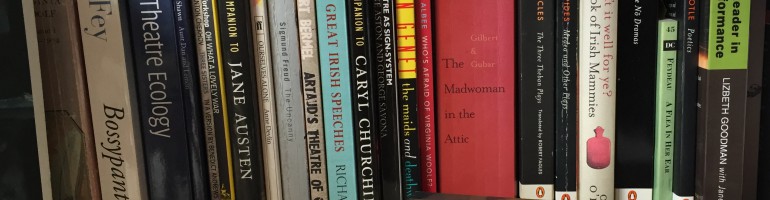
As a frantic third year during my bachelor’s degree, I ran around the library in my University continually frustrated with the literature I was reading, not to mention doing so while battling a hangover from hell. I couldn’t find any excitement in what I was reading because it didn’t relate to my anger and inquisitiveness (yes these emotions are quite close to one another), to what I wanted to try investigate as an upcoming dramaturg. I was constantly reading amazing literature from theorists like Judith Butler, Horkheimer and Adorno, brilliant mad men like Brendan Behan, and daring women like Marina Carr. But I wasn’t really getting that itch in my foot to kick arse within a theatrical space. Then I came across Anne Finch in the book Madwoman in the Attic by Gubar and Gilbert. I made this discovery while trawling through the bookshop Hodges and Figgus, trying to get more loyalty stamps so I could get another €10 off. I like to believe it was some magical literary moment, where the Gods of all the books in all of the land guided me to this book by some ephemeral music, and little fairies that live in bookshops lets call them ‘bookellas’, shouted with enthusiasm for me to buy this book. Unfortunately none of that alchemy actually occurred; the reasons for purchasing this book were superficial and mundane. I was attracted to the strange picture on the front cover and it was on discount with the other book I was buying. What is true is that it was “love at first read”. This entry is about how I became to understand the position of women and the impact they have in theatre. Specifically with the work of Caryl Churchill. Hopefully it maybe helpful to yourself as a reader to understand feminism and theatre.


Madwoman in the Attic is a literary analysis of the great nineteenth century female novelists. It is an interpretation that creates a thorough discussion about the female author, the construction of the female imagination and how women have been trapped in a liminal state of patriarchal standards of writing and constructing art. The reader is left with an expanded sense of awareness of the conventions that women in art and theatre are confined within. The reader is advised from the onset, that the approach to this work necessitates the ability to ‘examine, assimilate and transcend’. To truly make a positive change, a shift in consciousness is what’s required, therefore, we must follow that process.  It is not about demolishing, but analytically deconstructing the representation/semiology/linguistics of the female identity for the purpose of better growth for women, that they are not trapped in ancient forms of traditions, expectations and standards. That they are truthful to themselves which then filters to the construction of the female imagination and product. As a whole, their work investigates the traps women have unconsciously fallen as authors and readers, that we must take note of absolutely everything to truly create an authentic female. In doing so, feminism has achieved what it has set out to do, to create equal platforms that answer the needs of both genders equally. Bringing fourth, women and authors in the present moment, and the issues we must be aware of.


During my last year in college, I was completely and utterly fascinated by the work of Caryl Churchill. Cloud Nine, Top Girls and This is a Chair, entranced me by the intricacy of detail and dramatic scope, with a political and/or social trajectory that could make you laugh and cry at the same time. Churchill’s theatrical technique of doubled characters was particularly thought-provoking because this played with the audience’s expectations and process of narrative digestion. Why were the characters doubled? I ventured into one of her earlier works Owners, before the doubled characters had emerged. Owners is about the power of ownership, where she almost blurs the lines of ownership of our bodies and our property. Ultimately the play ends with complete destruction, the set and the characters crumble. Work after Owners most commonly had doubled characters, what had changed? In Fen most of the characters were quadrupled. While studying Churchill’s work, I did intensive research into four of her plays Owners, Fen, Cloud Nine and Top Girls. I was trying to find out the reasons for the doubled characters while exploring and the power they create within a playtext. Churchill has created all types of women in her plays, powerful women, conflicted women, historical women, who were divided between their idea of sexuality and the traditional ancient ideas of sexuality; women who were confused, irrational, rational, the list is endless. And what they had in common, they are struggling within an internal battle, they are in constant turmoil that divides themselves, creating fractures within the psyche, which brought my work back to Anne Finch’s poem, Whilst we beside you but as Cyphers stand. A cypher! What a perfect word to describe the construction of female identity. I do not say that with delight, but with some sense of relief and optimism, because this is the issue. Women have become cyphers to themselves because of the standards and expectations created by a patriarchal society. As women we have had no time to truly understand or even contemplate the needs and desires of the feminine principle. I am not talking about make-up and high heels, but women’s biological differences to men (child birth, menstruation, breasts). There is no room to be feminine within this society because it doesn’t exist. Instead we accept what is expected and get on with things. Churchill was visually exemplifying what women do everyday with her doubled characters, as a spectator this becomes troubling because, well, we have never witnessed this before or even begun to discuss this in any real way. Through analysing each play and the doubled characters I then created the Cypher complex to lend a higher understanding of the doubled characters and their dual images. Therefore the Cypher complex is a conscious and unconscious dual force of acceptance and rejection, accepting the male standards and male expectations and in turn rejecting their own biological femininity. I understand that it is problematic to define and theorise on this issue, but it is necessary, it follows Gubar and Gilbert’s process of examination, assimilation and transcendence. Resolution through all of the above as opposed to argument. I’m not a magician, I do realise problems are not resolved that easily, but I created it to begin a discussion with both women and men.


Furthermore I hope that creating the Cypher complex will help in the understanding of the construction and existence of certain female identity and female representation on stage and screen. And begin to create and accept feminine models of representation that answers the needs of women, that do not condemn women or men, but instead opens a dialogue for appropriate representation. It may appear to be a mad idea to some, utopian in efforts. It is not aimed at creating a utopia but to deconstruct and examine that what we perceive as truth in fact engulfs and enslaves women further. Decoding the cypher and solidifying the feminine.


To decode the cypher complex we can start by the following…


  1. Feminism for all-EVERYONE CAN BE A FEMINIST. It is not something you get printed on a t-shirt that you brag about to others, it’s meant to empower everyone. Please don’t be that person that says to a man ‘you can’t be a feminist, you have a penis’. Feminism was created to empower women and also to educate women and men about creating an equal platform.
  2. Stop judging women-Who cares what she is wearing, what she is doing, or how she lives her life, it is that woman’s choice. Nothing is achieved by being judgmental, let’s be honest it is just fear speaking when you judge. Encourage women and men to express their weird and wonderful selves, as long as it does not hurt anyone in a physical, psychological or emotional manner.
  3. Be kind-Before you shut down someone whether it is a woman or a man, try to gauge an understanding of their perspective. Be kind and understanding to everyone’s opinion, create a dialogue instead of a debate.
  4. SUPPORT-Women must support women, it is far more beneficial supporting one another. We can achieve far more if we invest our energy in supportive actions.
  5. Be understanding-I have heard a few of my friends and colleagues say ‘I don’t think I am a feminist because I have never read about it’. You don’t have to be erudite to be a feminist, to be a feminist is to have the desire and urge to want something better for all women. Fuck the books, create feminism based around you as a women and the women around you, what would help them. In turn as you help yourself and the people around you, it has this wonderful ripple effect.


The above points’ can apply to how you approach writing a feminist play. It does not mean you have to use the points rigidly but just to give you a higher understanding how a feminist play can operate, generate and hopefully create a new cocoon of thought about feminism in theatre in the current theatrical climate. One of which broadens our knowledge of feminism and encourages both theatre practitioner and audience to obliterate the fear of calling themselves a feminist, it doesn’t mean not shaving your armpits and making up plans on how to kill Andy Warhol, but to strengthen gender equality.


Thank you for reading this article, I would love to hear what you think about feminism and/if it has a place in your daily life. I will upload a bibliography of some books that I have read which have really helped me. And for any other information do not hesitate to contact me on the contact page. AND: remember…kick the fuck out of the day cause you’re amazing!


Thank you for reading!

All rights reserved to Katie Poushpom, k.e.cleary.

Leave a comment

Filed under theatre explorations

New method to perfect happiness.

Maybe this is the meaning to happiness in life...

I found this picture on the google machine, and it makes me laugh on so many levels. Dramaturg gone mad!

Leave a comment

Filed under Uncategorized

Dramaturg NOT Dramaturd.

Dramaturg not Dramaturd.

Far too often when people ask me about my job I hesitate to do so. Unfortunately the title of dramaturg denotes ambivalence and confusion. The profession of a dramaturg seems to be best understood within academic circles and irrelevant to many emerging theatre makers. Through my own experience in communicating with people both within and outside the theatre scene, it has provoked an all or nothing response. People who are familiar with the job and the position of a dramaturg seem to feel the need to explain everything and anything in what can only be described as an effort to prove their intelligence and sophistication. On the other hand, people who are unaware of the dramaturg jokingly overlook the role of a dramaturg because they are too distracted by the acoustic similarity between dramaturg and dramaturd. The goal of this entry is to outline some of my thoughts as a dramaturg; why a dramaturg is an important entity to involve within the theatre, what a dramaturg does, and how a dramaturg could benefit you and your work. The dramaturg has been an important figure within the theatre industry for over 200 years, yet dramaturgs still seem to look like lonely children in a playground tearfully asking the other children ‘can I be involved?’.

The meanings of the word dramaturg and dramaturgy are unstable, sometimes bitterly so- ‘Few terms in contemporary theater practice have consistently occasioned more perplexity’- yet both words can be traced back to classical antiquity.
Mary Luckhurst, Dramaturgy: A Revolution in Theatre, (Cambridge University Press), pg. 5.

The above quote is from Luckhursts beautifully informative book Dramaturgy: A Revolution in Theatre. For anyone aiming to learn a bit more about what a dramaturg is and the dramaturg’s relationship with the process and production of dramaturgy this book is a must have. Luckhurst covers the etymology of the dramaturg from the Greek Lexicon to the dramaturg’s position in the contemporary theatre. As a dramaturg, Luckhurst helped me understand what the dramaturg’s position is within the theatre structure, where are they positioned and why.
The dramaturg operates within the middle of the external and internal creative process. The dramaturg is the artistic medium that seeks to maintain the quality of art being created, like a quality surveyor. They have an understanding of absolutely everything within the dramaturgy of a production, and are then the voice of reason that reminds the production what is achievable within the creative process and what may be obstructive to it. Unlike any other position within the theatre structure, the dramaturg has the privilege of witnessing the creative process from close proximity but with an objective opinion. Fine then, if we take that into consideration what the frig is a dramaturg!

A dramaturg is a mediator and translator that exists in a neutral artistic position within the theatre. They mediate between the text/artistic intent/ performance to the Production Company and audience. It is the entity that harmonises the theatre company’s efficacy to the audience, acting as a mediator. It acts as translator within the company or production through intense research and development of the piece of work. By this process they have the integrity and insight to pose questions and creative opinions to ensure that the text to be performed is congruous to the efficacy of the production company. Therefore, from this, we can define the dramaturg as an artistic mediator and translator. Another definition of the dramaturg that can be considered is what The Dramaturgs Network notes, how the position of a dramaturg is constantly being considered a ‘luxury and not a rooted position in the theatre industry’. This is due to the vague definition of a dramaturg, dramaturgs duties can easily described as the duties of the assistant director or a literary manager. But it is possible to refer to the term and practice of mise-en-scene and how this process is unique to the duties of the dramaturg. Unlike a director, a dramaturg researches the mise-en-scene of a piece of work both on and off the stage. And unlike a literary manager, the dramaturg must understand the artistic and practical work that is involved. Therefore a dramaturg is a practical artist like a mettre-en-scene. So what does this mythical creature do?

Being a dramaturg is an ongoing consistent process of development. A dramaturg must always know what is happening within the theatre industry, what theatre productions are running, what they are about, do they refer to any social or political issues of the day, and also issues other practitioners are discussing, new waves of theatre and theatre making. Therefore, a dramaturg must be subsumed with theatre and dramatic practice. To understand a bit more of what a dramaturg does it can be broken down into the following tasks, this is an example they can differ with other dramaturgs, 1. Research and development: understanding what the text/ performance is, where it stands in the current theatrical climate, analysing political, social, cultural etc. implications or messages. 2. Understanding the needs and desires of the writer, director, dancer, company, what are the problems they are facing, 3. Creating reports as to what can be improved, 4. Setting up and developing workshops to help the work being created, 5. Constant work and advice with the writer, 6. Liaises with all members on and off stage as to what should be created to convey the best performance.

One of the questions my professor posed to me while I was doing my Masters Degree was about defining a dramaturg. I asked him simply what is a dramaturg and he effortlessly replied ‘it depends on the context’. I obviously listened with tremendous frustration, but later realized he was completely right. A dramaturg’s role differs in relation to the artistic structure. For example, it can be divided into the following: new writing, translations, adaptions and multi disciplinary collaborations. A dramaturg can decide to have proficient skills in all contexts or can specify to hone their skills in on one or two of them. Mary Luckhurst beautifully calls a dramaturg a ‘script doctor’, a person who with the skills of an editor, the knowledge of a stage manager and the voice of a director. Here are some topics of interest to all artists where a dramaturg can help you and the success of your work.

1. Emerging artists/playwrights:- a dramaturg can help you find your voice and place as to where your work is best suited. They can help you frame your work into a cohesive structure and strategy; e.g. creating creative plans as to how you approach your work. Help you define and redefine you own personal style. Giving you a broad amount of information about the theatre industry and creating a strategy where you can produce your work.
2. Established companies and playwrights:- assisting the director with creative decisions, staging, costume, character development. The dramaturg provides continual dramaturgical analysis that captures and reviews the play in its entirety with research of the intended vision; e.g. a dramaturg here is a mediator between the artists and the stage.
3. Theatres or general artistic institutions:- they can be used to help programme the yearly events, with reference to audience development and/or creative development and expansion.

If you are an upcoming dramaturg, or are within the industry and want to become a dramaturg you need to contemplate the following. (I have been witnessing many upcoming theatre practitioners who decide to become a dramaturg because it’s basically like being a critic. It’s not!). A dramaturg encourages and assists the artist in the realisation of their vision. Don’t get it twisted, be truthful in your work not mindlessly flippant.

• What is a dramaturg? What would I do if I was a dramaturg? Get an understanding of the meaning of a dramaturg and then outline your overall aim as a dramaturg.
• What does a dramaturg have to be qualified or experienced in? You must understand the arduous amount of work that it entails to become a dramaturg.
• What is my aim or objective in choosing such a profession? For this question you can make a work mantra for yourself that you would like to follow, or an artistic policy and mission statement. This question is especially valuable when people ask you about you and your work.
• What is a dramaturg’s position to the process or structure of dramaturgy? This is a big question, so takes some time to answer it. Keep in mind what has been said briefly in this entry.

Research about what has been done previously by Dramaturgs, even into where the word dramaturg came from, where does it originate? Become familiar to what is happening currently with dramaturgs, what are they doing and talking about. And don’t forget to check out websites such as Dramaturgs Network, Ideas Tap, Culture Hive, The Stage, newspapers and other blogs made by dramaturgs. Stay tuned to this blog for more entries of interest and artistic outbursts. AND don’t forget: Never let anyone deter you from what you want to do in theatre land, if they don’t provide the same creativity and kindness, give them the ole ‘fuck you’.

If you could leave comments about your experiences I would love to hear them, good, bad or indifferent. Thank you for reading!

All rights reserved to Katie Poushpom, k.e.cleary. Robbers will be punished severely.

Leave a comment

Filed under theatre explorations