The Dramaturg Report
The dramaturgy of any play text can be best described as being similar to how a kaleidoscope operates. A kaleidoscope has different shapes and colours strategically positioned within a precise framework. Constructed to effectively and beautifully move and configure to form intricate images. Which is never disjointed without reason, always remaining in harmony with all aspects of the kaleidoscope. The cylinder stage, placed directly in front of the enthusiastic viewer. Such a simple concept combined with such a complex structure, aesthetically and contextually bewildering their audience.
All of a sudden a dramaturg comes in and gently grabs the kaleidoscope and smashes it on the ground.
The viewer stares despairingly and confused at the dramaturg.
The dramaturgs explains…’don’t worry, now I can help you put it together but through the art of ballet’.
And that is the job of a dramaturg. Don’t worry dramaturgs aren’t that violent, that all ended with G.E. Lessing with his hatred for actors and actresses back in the 18th Century. Dramaturgs are becoming a more well known profession, although, there still seems to be a vague cloud of confusion of what they actually do within the theatre industry Which is when I decided to start writing the Dramaturg report.
The dramaturg report are entries of my adventures, maybe adventure is a bit of exaggeration, but my experiences of being a dramaturg. Also some additional information about Dramaturgs and Theatre land both past and present. And beginning to write these entries is a bit like picking up a broken raw egg, you don’t really go at it with any plan but with a lot of implements and anxiety. There is egg everywhere, picking it up just seems to make the rest of it spread and wriggle everywhere. You don’t know what to do because its not just on the floor but on your clothes, some has even landed on the dog!
Anyway I digress, these entries are just about the daily happenings of a dramaturg, pursuing a somewhat strange and unconventional endeavour in theatre.
ACT ONE
DEUS EX MACHINA MOTHER FRITTERS
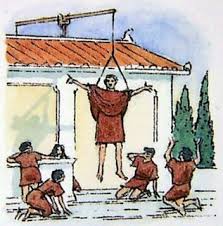
It is I, now smell my feet.
At the moment I am reading a theatre dictionary, and it is the most fascinating book I’ve read in a long time. At the end of each definition there are more words to guide you through the book at random. Each word bringing you to a new linguistic destination of information. Not to everyones taste, I understand, because everyone else must be empty inside.
I re-found Deus ex Machina and remembered all of its dramaturgical magic. Here is the phenomenal definition below. Look below these words and you will find it…now.
DEUS EX MACHINA
In a play, the sudden and unexpected appearance of a new character, who immediately resolves the complications of the plot. The term comes from ancient Greek tragedy, in which the deus ex machine would be a god lowered mechanically onto the stage to settle all disputes.
It’s so random and insane its genius. Dramaturgically it’s both anticlimactic and climatic. It resolves everything directly in the middle of the most important action in the plot which could be frustrating to an audience, but it also lands at the apotheosis of the plot which makes it incredibly exciting. The image of a God randomly mounting his/ her self in the middle of a Chekhov draws the biggest smile to my face with excitement. Dramaturgical advice: Why not if you are struggling with you writing , just pop in a God, play finished. Not a wonderful ending but you can have the satisfaction of allowing yourself to think that you finished your play for the day. Not convinced let me bring your imagination to a scene from “Three Sisters”.
VESHININ: I’ve got quite filthy in the fire, I look like I don’t know what.
(A pause)
Yesterday I heard a rumour that they’re planning to transfer our brigade somewhere far off. Some are saying to the kingdom of Poland, others to Chita.
TUZENBAKH: I heard that too. Then the town will be quite empty.
A crash is heard off stage. All of a sudden a bright light is witnessed in the flies. A large gathered gold drape is witnessed with a God delicately positioned in the centre of it. It is awkwardly lowered to hover over the characters on the stage.
GOD: It is I, the God of all things great and sugary. Everything is now resolved and all of the buildings have been miraculously repaired and rebuilt. So we can end the play here. Why, because I said so! Boom! I must leave to further help other distressed plots and maybe some audience members so they can leave soon and get a quick drink. I must leave
Begins to be raised by up to the flies
THE END.
More to the point I was reading the dictionary for my own snots and giggles and for research and development. But it is not R & D like you have ever seen it before, its dramaturg R & D! This involves not only researching all the fine intricate details but forming an established opinion of how all these parts correspond to the particular theatre piece. My own R & D at the moment is for Theatre Bounds project, Dollamine adaptionsg©. Adapting classic plays you know and love, which are re interpreted through dolls.
There are a few creative limitations that pose a bit of a threat to the dramaturgy, their lips don’t move, or their legs, and trying to stand them up is like trying to stand up a drunk friend at the bus stop. The play I chose was Oedipus by my new best friend Sophocles. Transforming an ancient Greek play does not necessarily translate as imminently as I would of hoped, although writing and reconstructing the text was actually really enjoyable. The poetics and syntax of the play is beautifully thought provoking, every line has dramaturgical poignancy to the dramatic structure and Oedipus is actually really funny…at times.
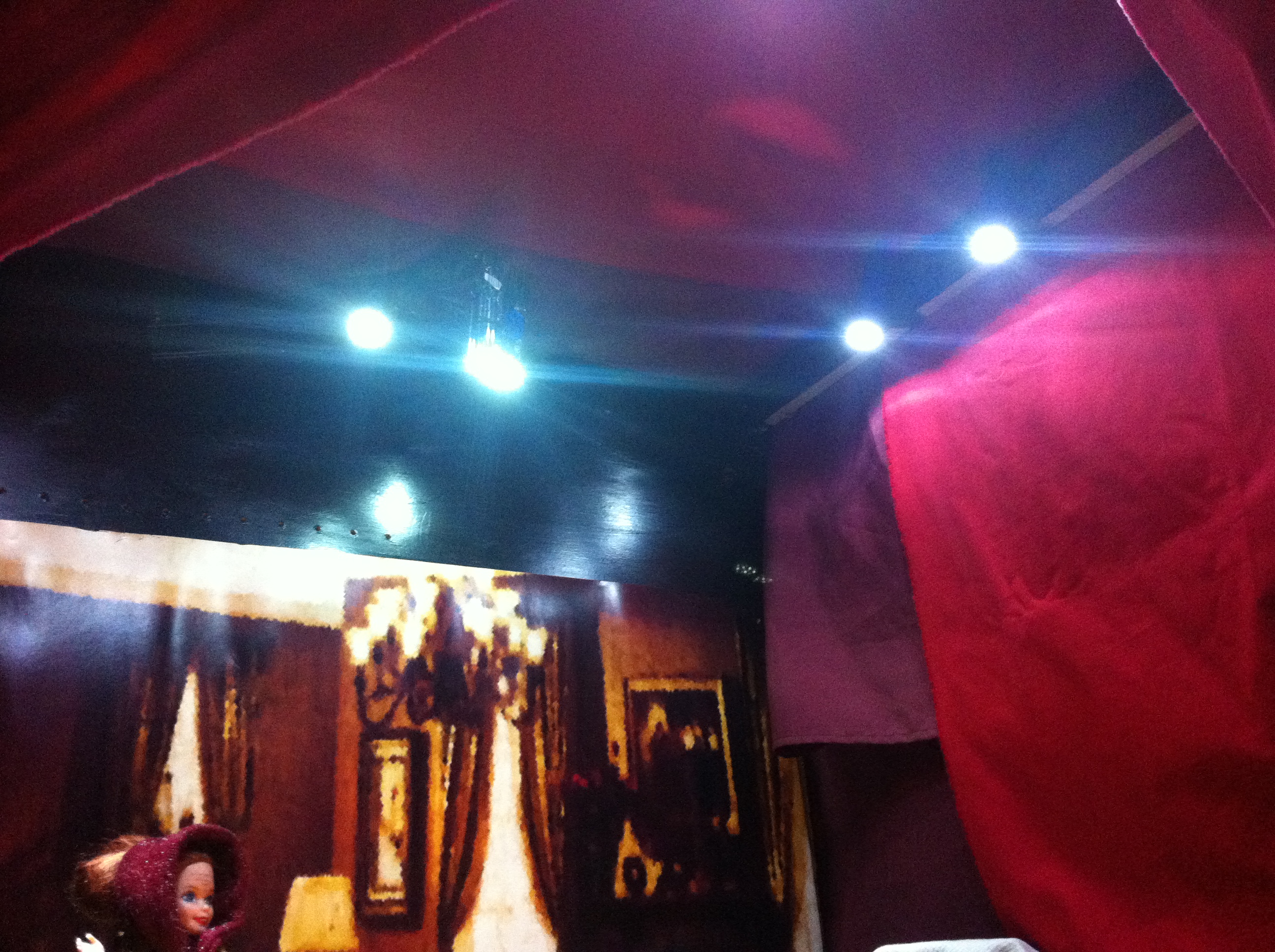
For Dollamine adaptions© the main components for dramaturgical attention is the medium being used and style of the text. But because this is an unconventional form of theatre making I didn’t have my usual modes of practice so I started with dividing everything into image and sound. Thanks to Sophocles writing a 15 minute adaption came quite easily and dare I say enjoyable. Unlike creating the image…the dolls…the fucking dolls…
Instead of describing the dramaturgical troubles that ensued I shall show you some photos. As John Montague once described in one of his poems words are limited where as images, really show the gritty graphic shit, or something along those lines.
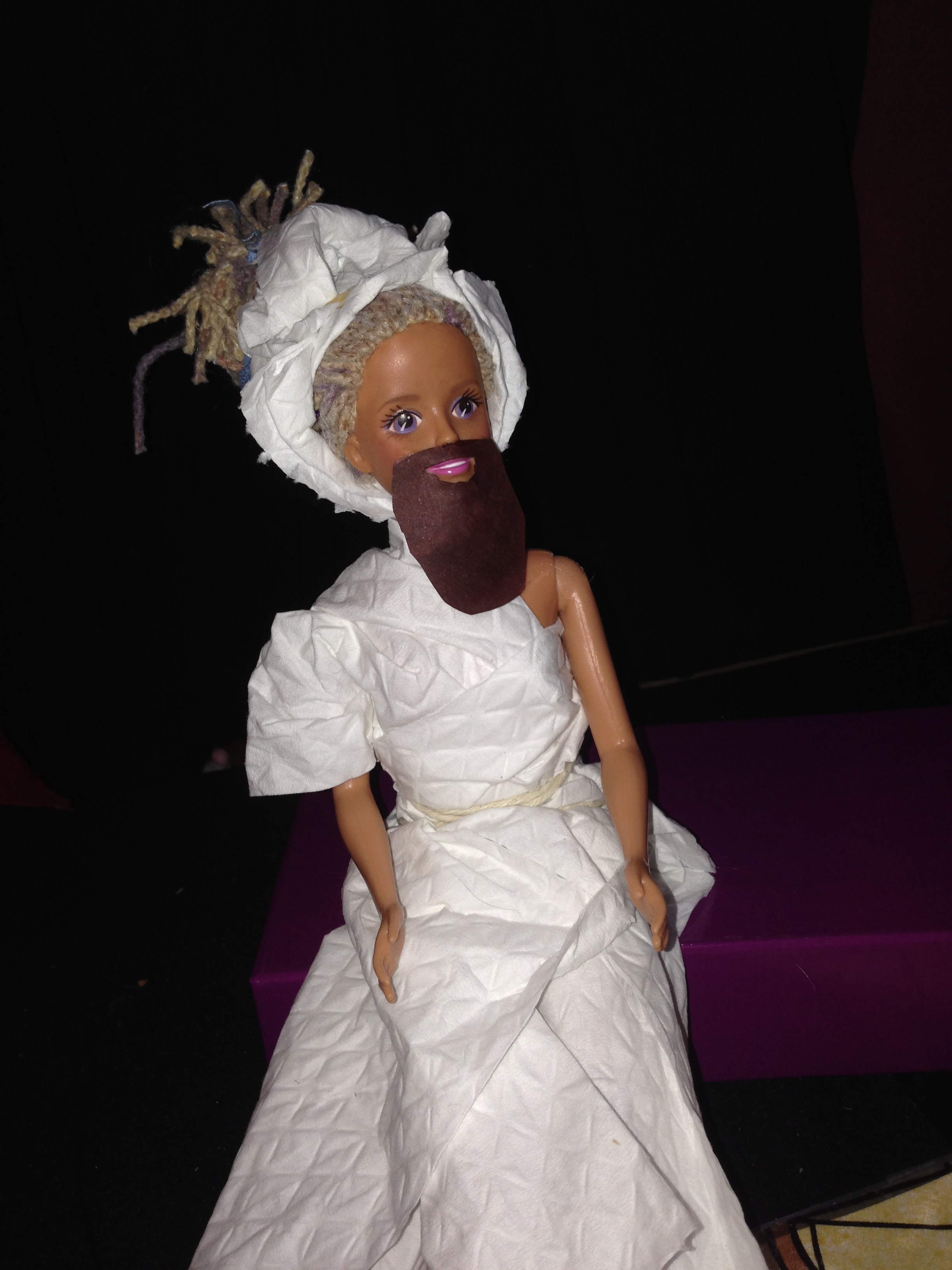
Half way through production I realised I was not a fan of male dolls as a child and had to improvise. Meet Cindy/ Cillian.
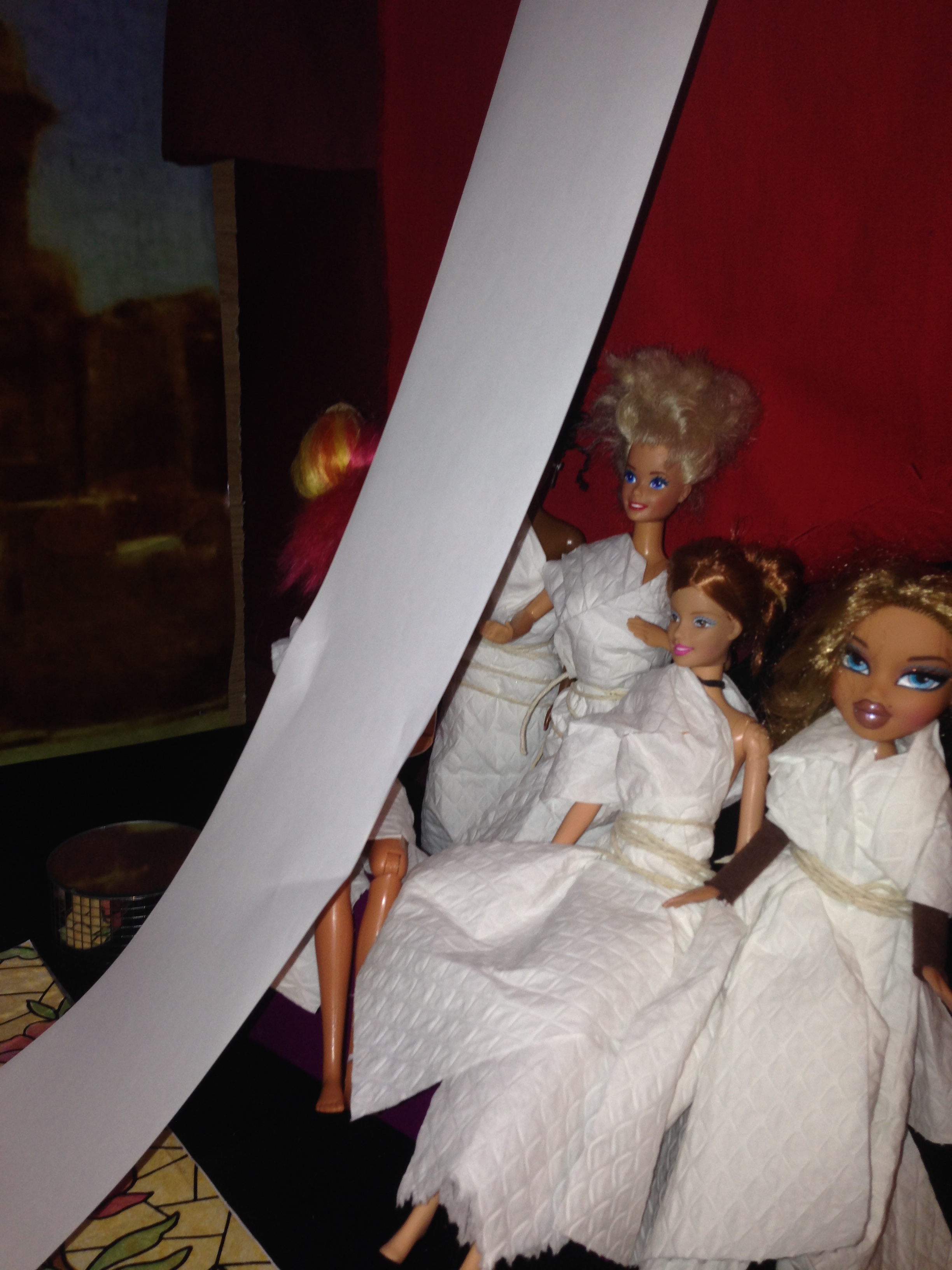
Then the set decided to fall apart. Oddly enough this was the only time the dolls didn’t budge.

Quick production meeting with the cast.
Does not mean I don’t enjoy dramaturging (not a real word but I feel it should be)Dollamine adaptions© ,but its always better to show the reality of theatre work. Especially such work that would make Tracey Emin say ‘what the fuck’.
But the biggest lesson I learnt as a dramaturg while working on Dollamine adaptions© that summarises up the profession in one line is…wait what was that.
DEUS EX MACHINA MOTHER FRITTER
Dramaturg-Tree!
All rights are reserved to Katie Poushpom.
 The Madwoman in the Theatre.